Showing posts with label Batman. Show all posts

Tuesday, October 23, 2012

Crowd Pleaser

That might be a slaphappy description of comic artist Alan Davis, one of my all-time favorites, but sometimes it fits. Sometimes, when he himself isn't scripting, snarky elements pockmark his spritely, winsome storytelling. That isn't to say DC's new hardcover volume of his Detective Comics run isn't great. But his work on Captain Britain and Excalibur reveal a wunderkind imagination. Here, in the grimy Gotham of 1986, we get the draft-horse.

Glowingly reprinted, these issues feature writing by Mike W. Barr, who often throws a schizophrenic light on the Caped Crusader. We see wacky uncle Batman from the 1950s, consistently calling Robin "chum" (because nobody wants to say "Boy Decoy" out loud) and fighting for his life on a giant pool table. We see the brutally sadistic Batman, known contemporaneously in Frank Miller's The Dark Knight Returns. We also see the teacher-detective, who actively quizzes and castigates Robin to sharpen both his ward (Jason Todd, during this era) and himself.

This last isn't always done perfectly. In a vague exchange that can be read as adult, for giving the audience just enough, or sloppy, for needing a bit more context, Batman, Catwoman and Commissioner Gordon puzzle out a clue from the Joker. When Robin massages his fist with glee and says, "Let's go," Batman grabs his shoulder, wags a finger, and says, "Never do that again." A question mark pops from the twelve-year-old's head, and readers unfamiliar with this run must assume Jason hasn't yet encountered the grinning madman.


Unfortunately, pandering to Miller's audience is done almost too perfectly. During one scene, Batman asks an information broker named Profile about the Joker's whereabouts. The man's haircut and nail varnish tell us he's gay. When he puts down a narrow, empty wine glass, Batman picks it up. He asks Profile whether or not he's been to prison... while cramming his fingers into the glass. "You'd be real popular up there," he says, "if you catch my drift." The threat works, and Profile reveals a location. One panel later, Batman pops the slim glass with his fingers, grinning maliciously.

Back then, before superheroes in Hollywood catered to families, this kind of thing surely had the maladjusted set rolling in their parents' dens. As an adult reader (who's seen almost everything) seeing it for the first time, I'm scandalized enough to give it two paragraphs. No Batman comic could show such a thing today.

Well, onward and upward. But not by much, yet. Another infamous moment is more of a commentary on the Batman and Robin thought to exist, back in the 40s. After the war, when over-educated adults had nothing better to do than read their own idiocy into children's entertainment, a man named Fred Wertham claimed the Dynamic Duo were lovers. Here, Barr and Davis offer a scene with Robin using a fire-hose on Batman before he enters a blazing car wreck. "Good boy!" says Batman. "Hose me down now! That's it, good and wet..."

I doubt this is innocent. The previous example of tastelessness, coupled with the fact that this editorial team later let readers vote via 800 number whether or not kill Robin, makes it hard to believe the slightest perversion wasn't premeditated (readers did want him dead, by the way, so the Joker beat him to red, green and yellow paste).

My final complaint regards Davis drawing Batman at all. Why use poppy seeds when you need gunpowder? Gotham is too dark a place for Davis' ethereal women, pixie-ish sidekicks and lithesome, David Bowie-style heroes. He also draws aliens and weirdos so well you'd think he shared a room with them (an Excalibur post before the year's over, I promise).

That said, near the end of this volume we get another reprint of the Batman: Year Two storyline, featuring a murderous vigilante called the Reaper. The tale's second half, Full Circle, boasts the subtle, highly-rendered coloring of Tom Ziuko. Davis' longtime inker Mark Farmer chimes in here as well, adding to the cinematic tension that streams from the artist's every panel. It's Davis at his best, so far as Batman goes.

Which makes for some layered reading. Taken as a snapshot of his transition to the gloomy Dark Knight of the 1990s, these issues allow our hero to wonder, "...if [Bruce Wayne] even exists anymore, or if he's anything but another disguise[?]" This question is answered best by other writers, in larger stories. Here, though, you'll see Batman smirking like there's no tomorrow.

Wednesday, September 12, 2012

Hit Me With Your Best Shot

For the week of September 12, 2012, I've plucked two comics from an enormous batch that, month after month, prove themselves priority reads. First up is Batman, by the endlessly inventive team of writer Scott Snyder and artist Greg Capullo. With this being another issue 0 origin story, you might point out that Batman: Year One covered the beat flawlessly back in 1986. Or that Batman: Earth One polished the well-trod material just last Spring.

But history doesn't stop Snyder and Capullo from delivering the best of DC's New 52, and what often feels like the best comic currently published anywhere. History, in fact, greatly enables Snyder, who loves strengthening Batman's ties to Gotham city. "What was once old," says a bank manager on the opening page, "will be new again." He no sooner slices into a cake sculpted like his bank than the Red Hood Gang charges in for a hold-up.

The Red Hood was actually the Joker's first criminal guise, according to a tale from the 50s. This character, grinning from under a shiny red helmet, orders one of his men to "put down" the banker. The thug pistol-whips the man instead of shooting him. Within a few tense panels, the Red Hood becomes sure of an imposter in the ranks, and says, "You're going to blow your brains out. Right here, right now." Unmasked, with a gun in his mouth, the imposter hesitates. "Come on already, will you? This is getting old!" A young Bruce Wayne, daringly disguised, says, "Then let me make it new for you."

Our hero's escape from the bank, through the sewer, showcases Capullo's masterful cinematography. His shadows are deep and his tech is thrillingly employed. The rest of the issue, an extensive chat between Bruce and Jim Gordon, shows that both are subtly younger, this tale being a flashback, and a neat bit with one of the first batarangs reveals creative minds never at rest.

Meanwhile, across the publishing pond at Marvel, a loud and all-consuming Summer crossover is finally about to croak. The penultimate issue of Avengers vs. X-Men is here, but don't worry- I won't spoil it like a certain New York newspaper did. The series itself needs summarizing, and I'll be struggling words-wise to meet the sheer majesty of Olivier Coipel's art.

Conceived and delivered by five of the company's best writers, this mega-brawl sees humans and mutants alike staring down the Phoenix, a cosmic force that manifests though (and typically corrupts) a super-powered host. The first and best time around, the Phoenix took over X-Man Jean Grey. She went insane with power, killing billions and eventually herself. This time, the Phoenix force is shared (ironically) among five heroic mutants: Cyclops, Emma Frost, Namor, Colossus and Magik.

To spite the all-powerful Phoenix cabal's fascist correcting of worldly ills like hunger and war, the Avengers have confronted them repeatedly. The rest of the mutant X-Men, pawns of the cabal, have battled Captain America and Iron Man's team to a stand still each time. Nevertheless, members of the cabal have fallen, as the Phoenix force flees a weakened host to reside in a stronger one.

Which brings us to today's issue. Cyclops and Emma are the last two hosts. Scribe Brian Bendis keeps his woefully rambling dialogue fairly sharp as they contemplate turning on each other. "We have the power to remake the world the way it was always supposed to be," Emma says. "If not us, who? This is how things like this are done."

Even when focused, Bendis pads his writing like a couch fort. But visionary artist Coipel tells more of this story than any writer could anyway. Inker Mark Morales and colorist Laura Martin help, buffing his already electrifying layouts into pop magnificence. Not since Jack Kirby, John Buscema and other 60s greats invented what superpowers in action should look like has comic art been so satisfying to behold.

An early shot of the Avengers and X-Men embracing is a tarot card of sorts. Then again, the result of this series is already being advertised relentlessly. The two headlining teams, once they merge to defeat Cyclops' Dark Phoenix persona, will stay together, like the Avengers themselves did after battling Loki decades ago. Politics in the Marvel Universe might change, with mutants gaining a bit more legitimacy. That, or the Avengers could be branded public enemies. Realistically, a wonderful third option awaits readers, because they'll jump off just about any cliff at the House of Ideas. We don't dare look away.

Wednesday, August 22, 2012

Schrodinger's Cat and the Men Who Feed Her

Possibility, identity, and the merits of multitasking are celebrated in a trio of comics released today, August 22, 2012. I'll start with the first issue of Before Watchmen: Dr. Manhattan, because Adam Hughes' art is both impossibly refined and ecstatically delivered. Known today mainly for his sensual Catwoman and Wonder Woman covers, Hughes' sequential interior work is rather rare. He had notable runs years ago on Justice League America and Ghost, but the privilege is entirely ours to see him telling stories again.

Dr. Manhattan, of course, is the blue naked guy from Watchmen, DC's bestselling 1986 graphic novel. After a lab accident atomized his human body, Dr. Jon Osterman reconstituted himself by manipulating his own "intrinsic field." This brought him awareness of himself at every age, throughout time, simultaneously. Don't fret. This isn't a physics lesson delivered by the Blue Man Group. Writer Alan Moore's eery take on the subject makes Watchmen one of the most engaging reads comics can offer.

Here, Babylon 5 creator J. Michael Straczynski impeccably mimics Dr. Manhattan's chilly, present-tense narrative, established by Moore. With the place and time being Germany, August 14, 1938, Manhattan says, "I am nine years old. I am unwrapping a birthday present from my father. Quantum Physics," he continues, envisioning a kitten, a baseball mitt, a teddy bear, "says that as long as the box is closed, it could contain anything, in any state of existence."


Hughes' remarkable page layouts (sepia tinted by colorist Laura Martin) answer the age-old question, "Should Norman Rockwell have tried working with spray paint?" Absolutely, he should have. "The present is wrapped," Dr. Manhattan later says, watching his human self enter the intrinsic field chamber. The door then closes and locks, before destroying him. "What's inside the box?"

A question for next month. Right now, "Who is Matches Malone?" is a puzzle we can tackle by reading the third issue of Batman Incorporated. By writer Grant Morrison and artist Chris Burnham, this title pits Batman and Robin (three different Robins, actually) against a worldwide criminal syndicate called Leviathan.

The concept plays deftly to Morrison's strengths, which typically involve freakish disguises, bloody rituals, and just about anything else the cerebral Scotsman dreams up. Here, we get Bruce Wayne undercover in mob territory as Matches Malone, an info-trading weasel who dresses like something washed up from the dismal shores of 1974 (the era, in fact, of his creation). Burnham, a relative newcomer with a full-bodied, kinetic style, is the perfect artist to enliven the lunacy lurking in Morrison's mind.

Morrison himself dazzles in this issue, serving up playful slang in one crisp course after another. "I've heard a few things about you," says torch singer Lumina Lux to Malone, "but nobody prepared me for Sir Galahad." He answers, "I'm like true love and nuclear war- there's no way to prepare for Matches."

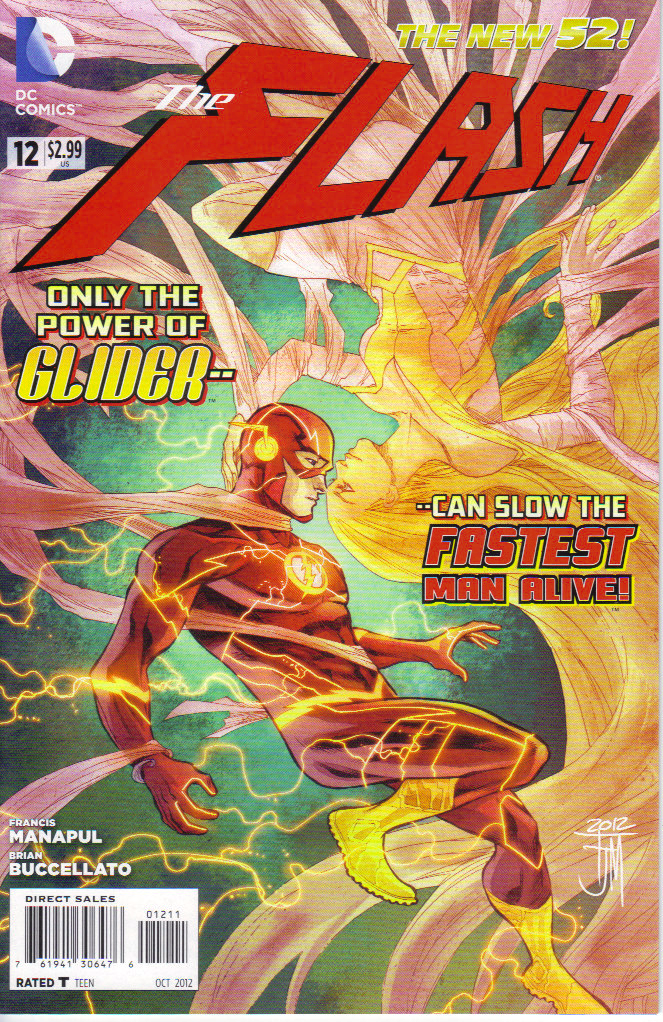
Similarly, there's little preparing for how incredible The Flash is, considering that most comics revitalized by the brilliant Geoff Johns end up shriveled on the vine (I'm looking at you, Hawkman and Justice Society). But this version of the fastest man alive, co-written by artist Francis Manapul and colorist Brian Buccellato, is an issue-for-issue masterpiece.

Manapul, once criticized publicly by writing partner Jim Shooter for weak cover art, now generates routine brilliance. Once establishing that the Flash should think as fast he moves, his writer/artists have sprinkled micro-panels throughout his world, illustrating our hero's quick moments of insight. Consistently iconic paneling also highlights the Flash's many Rogues, who frequently gang up against him (and each other). The cherry atop all of this is Buccellato's coloring, which is almost too beautiful for comics. Using subtle watercolor hues for the backgrounds, his boldly painted figures race through the Twin Cities of Keystone and Central.

This issue sees the Rogues Captain Cold and Heatwave under arrest and in armored transit. Cold's sister, the ethereal Glider, uses her phasing power to dump the police escorts and free Heatwave. Cold himself is rescued by the vigilante Pied Piper- in short, The Flash is never a dull read. Especially when Glider and Mirror Master steal a runaway monorail. I just have to wonder if Manapul would be so incredible if not made a fool of by an industry vet who should have had more class. Or maybe Shooter should run his mouth more often.


Monday, July 30, 2012

Open Sesame

SOCK! ZAP! KAPOW!

A few words of welcome to a new comic book blog, for you the reader and me the writer. I love (mostly) all things superhero, and plan to discuss comics and graphic novels as high art, rather than the cheap escapism they frequently are. Every Wednesday, I cash-dump religiously at my local shop for magazine comics. But I also have a sparkling cache of trade paperbacks, and if they don't join me in my grave it's because they've buried me here in my room.

Right to it then. The last face-breaking chapter in Christopher Nolan's Batman film trilogy, The Dark Knight Rises, has had me exploring various print eras of the Caped Crusader. The original 1940s run by his creators, writer Bill Finger and artist Bob Kane, is collected by publisher DC in lovely, light-weight trades that they've dubbed the Chronicles. They present "all the Batman stories in the exact order they were published," which makes for fun, illuminating reading by casual readers and would-be comic historians alike.

I grabbed volume three at Harrison's Comics and Collectibles (one of the best reasons to visit Salem, MA), and was soon up to my pixie boots in stiff uppercuts and body-slams. This volume includes Batman 4-5, Detective Comics 46-50, and World's Best Comics 1, from 1940-41. Noteworthy bits I should have expected but didn't quickly became apparent in my devouring of the material.

Detective Comics primarily features Batman and Robin's battle against gangsters and social injustice. One tale is about a banker with no time for his son, who ends up paying blackmail money to the teen's crooked friends. Much action ensues, including the stiff uppercut and body-slam that artist Kane includes in virtually every issue. After events wrap up, the last panel has our heroes' civilian identities of Bruce Wayne and Dick Grayson share this moral nugget: "Mr. Midas has decided to take a little time off from business and become a real pal to his son! Other parents can take a tip from this case! It's well worth thinking about!"

Er, thanks Bruce. Do all your sentences end in exclamation points? That would be yes, except when they end in question marks or ellipses. Still, such tales are told with the genuine mirth and energy of a genre cutting its teeth. In the beginning, before Batman became terrifying, he made quite free with the sarcasm. Stan Lee later infused most of his characters with a healthy dose, most notably Spider-Man.

In the Batman comic, which was a quarterly release, not a monthly like Detective, Finger and Kane threw the Dynamic Duo into surreal situations that their other magazine precluded. They faced pirates, the Joker and a slew of traditional fairy tale creatures. These adventures foreshadow the "crazy uncle" Batman of the 1950s, when the Comics Code kept him and Robin from street-fighting gangsters, and they instead encountered aliens, imps and even Batman of the year 3055.

Also noticeable is the difference in reprint coloring quality between the Detective Comics and Batman issues. Detective is less vibrant, with paler background and flesh-tones. Only the Dark Knight himself and the occasional fire truly jump from the page. But Batman's illustrations tout the immediacy and warmth of bright green, orange and purple.

Kane's art in both comics, however, is beautifully clean. His textured backgrounds and midnight ambiance make the reading a world unto itself- a world we can thankfully revisit in any of eleven Chronicles volumes (so far).