Showing posts with label Before Watchmen. Show all posts

Wednesday, September 5, 2012

Statements of Purpose

Tackling controversy in comics doesn't always make a writer great, but great writers sure do love it, as shown in my September 5, 2012 batch of comics. Geoff Johns, who just last week wrote a kiss between Superman and Wonder Woman, this week gives us a newly minted Green Lantern, seen here brandishing a handgun. Yes, your eyes are working. That's a Green Lantern, whose magic ring allows him to create anything from pure willpower, exercising his 2nd Amendment right.

Johns' indictment of this miserable fact of American life couldn't be harsher. That is until you read the new Green Lantern's origin in this special issue. Simon Baz is his name. He's an Arab American, from Dearborn, Michigan, raised in the Post 9/11 World. Typical scenes from his youth include: washing graffiti from the walls of an Islamic Center, standing up for his sister against bigots, and patiently awaiting security to clear his passage.

Artist Doug Mahnke, whose monstrously fertile mind usually fills this comic with bizarre creatures, has only terrestrial terrors to illustrate here. A few pages in, we find Baz driving a truck with a bomb in it. As a car thief, he didn't know about the armed device, but Johns once again leans as heavily as possible on this hot button. Later, a trip to an island prison for hooded "interrogation" seems to finally clear the deck of scathing commentary.

Baz is rescued from a water-boarding by a glowing green ring that bursts through the ceiling. "Simon Baz of Earth," it says, in standard greeting to a new bearer, "you have the {ERROR} ability to overcome great fear." The error is new, but what it means is probably a twist for later. Another war is brewing in the four Green Lantern titles, and as I've said before, if Johns himself wouldn't love to read it, he doesn't write it.

The same is easily said of Dan Slott, who writes Amazing Spider-Man with the maniacal pride of a circus ringleader. Evidently a careful student of comics for decades, Slott fearlessly spins the many plates that keep readers obsessed: a flawed, sympathetic hero, a great supporting cast, and agile, in-character dialogue. Mary Jane's assertion that, "You're not who you are because your Uncle Ben died. You're who you are because your Uncle Ben lived," is brilliant regardless of story or context.

Slott also happens to out-plot the rest of Marvel's entire writing stable (sorry, Jonathan Hickman). His latest opus sees scientist Peter Parker inadvertently invest high school student Andy Maguire, whose class visits Horizon Labs, with Great Power. Next must come Great Responsibility, or so hope the Fantastic Four and the Avengers, because Andy's now possessed of super-speed, super-strength, and capable of shooting energy/creating a force-field. Character-wise, he's an unknown quantity, and all the other heroes insist that Peter wrap the lad in some fatherly webs.

The poignancy of Spider-Man getting a sidekick for his 50th Anniversary would be a story for the ages. This isn't that story. Andy, as the hero Alpha, is a solid-gold asshole. When not endorsing gadgets, tongue-wrestling chippies, and getting himself kidnapped (and cloned, WHEEE) by the Jackal, he finds time to call Spider-Man his sidekick. In this portrayal, Slott eviscerates our modern up-from-the-dumpster celebrities, who routinely perform career-destroying acts of idiocy and then bow.

Humberto Ramos, one of the first (and hardest working) manga-influenced artists of the 90s, is deep in his A-Game this month. He excels in drawing emotion, both exaggerated and subtle, and this being a less cluttered story than last year's Spider-Island, we get the full brunt of his talent on every page. Peter appears grim indeed after deciding, "His power is my responsibility. That gives me all the say I need. And I say- Alpha: No More."

But dire sentiments need not taint this entire review (for two paragraphs, at least). Before Watchmen: Silk Spectre, by the Eisner-Deserving team of Darwyn Cooke and Amanda Conner, is a spectacle of light, color, and one man's dong (on page 18). Yes sir, this is a comic that takes full advantage of its counterculture backdrop. The first quarter features our heroine, previously seen in the 1986 graphic novel Watchmen, tripping at a love-in and talking to the skeleton of her beloved bird Lamb.

The whole is exquisitely drawn by Conner (and psychedelically colored by Paul Mounts), who along with Becky Cloonan and Nicola Scott, is one of the best artists working today who happens to be female. Most of this comic sticks to the nine panel layout artist Dave Gibbons laid down in Watchmen, and is more cinematic for it. This is especially true when Cooke gives us two dialogue-free pages of the mercenary Comedian visiting the Spectre as she sleeps. She doesn't know it, but the vile man's her father. He drops a note on her dresser, pets her cat, and then leaves grinning. She's taken after him, naturally enough, kicking open doors and heads for the greater good.

Despite a slap-happy tone, however, this comic is unabashedly cynical. It gives us a drug lord, modeled on Frank Sinatra, who preys on those desperate for enlightenment. Elsewhere, a doctor tells Silk Spectre, "You kids had better take it easy on those acid parties," smoking with his nurse, "they could be detrimental to your health." In recent memory, the TV show Mad Men has also raked the Boomers over the coals for that one. Cooke, who wrote an awe-inspiring tribute to the early 60s with New Frontier, surely has more to say on the decade's second half. Here I hold my breath, awaiting the education.

Wednesday, August 22, 2012

Schrodinger's Cat and the Men Who Feed Her

Possibility, identity, and the merits of multitasking are celebrated in a trio of comics released today, August 22, 2012. I'll start with the first issue of Before Watchmen: Dr. Manhattan, because Adam Hughes' art is both impossibly refined and ecstatically delivered. Known today mainly for his sensual Catwoman and Wonder Woman covers, Hughes' sequential interior work is rather rare. He had notable runs years ago on Justice League America and Ghost, but the privilege is entirely ours to see him telling stories again.

Dr. Manhattan, of course, is the blue naked guy from Watchmen, DC's bestselling 1986 graphic novel. After a lab accident atomized his human body, Dr. Jon Osterman reconstituted himself by manipulating his own "intrinsic field." This brought him awareness of himself at every age, throughout time, simultaneously. Don't fret. This isn't a physics lesson delivered by the Blue Man Group. Writer Alan Moore's eery take on the subject makes Watchmen one of the most engaging reads comics can offer.

Here, Babylon 5 creator J. Michael Straczynski impeccably mimics Dr. Manhattan's chilly, present-tense narrative, established by Moore. With the place and time being Germany, August 14, 1938, Manhattan says, "I am nine years old. I am unwrapping a birthday present from my father. Quantum Physics," he continues, envisioning a kitten, a baseball mitt, a teddy bear, "says that as long as the box is closed, it could contain anything, in any state of existence."


Hughes' remarkable page layouts (sepia tinted by colorist Laura Martin) answer the age-old question, "Should Norman Rockwell have tried working with spray paint?" Absolutely, he should have. "The present is wrapped," Dr. Manhattan later says, watching his human self enter the intrinsic field chamber. The door then closes and locks, before destroying him. "What's inside the box?"

A question for next month. Right now, "Who is Matches Malone?" is a puzzle we can tackle by reading the third issue of Batman Incorporated. By writer Grant Morrison and artist Chris Burnham, this title pits Batman and Robin (three different Robins, actually) against a worldwide criminal syndicate called Leviathan.

The concept plays deftly to Morrison's strengths, which typically involve freakish disguises, bloody rituals, and just about anything else the cerebral Scotsman dreams up. Here, we get Bruce Wayne undercover in mob territory as Matches Malone, an info-trading weasel who dresses like something washed up from the dismal shores of 1974 (the era, in fact, of his creation). Burnham, a relative newcomer with a full-bodied, kinetic style, is the perfect artist to enliven the lunacy lurking in Morrison's mind.

Morrison himself dazzles in this issue, serving up playful slang in one crisp course after another. "I've heard a few things about you," says torch singer Lumina Lux to Malone, "but nobody prepared me for Sir Galahad." He answers, "I'm like true love and nuclear war- there's no way to prepare for Matches."

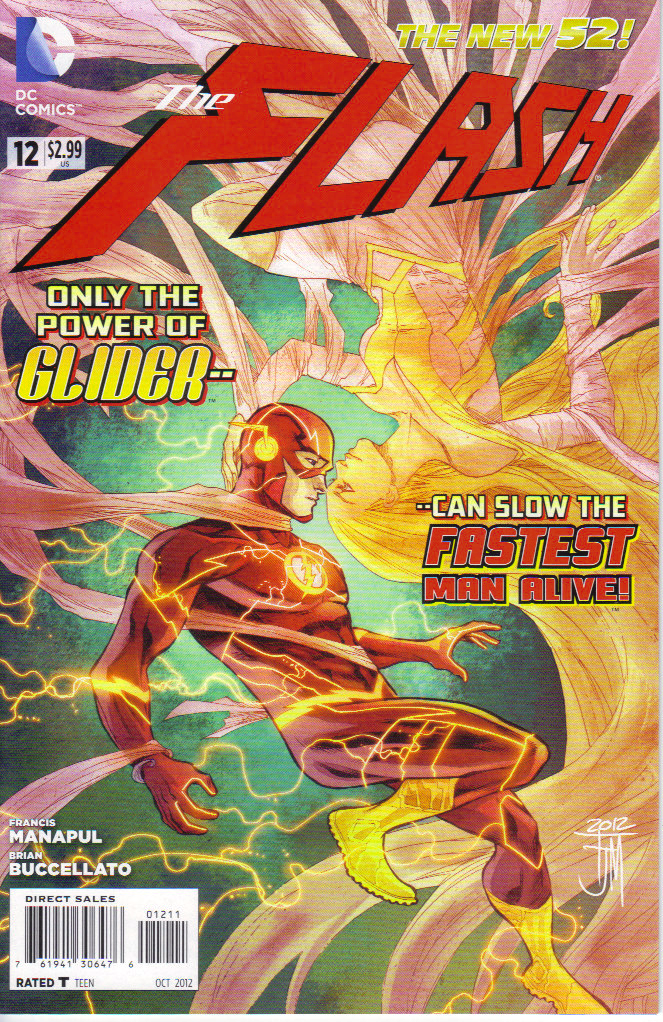
Similarly, there's little preparing for how incredible The Flash is, considering that most comics revitalized by the brilliant Geoff Johns end up shriveled on the vine (I'm looking at you, Hawkman and Justice Society). But this version of the fastest man alive, co-written by artist Francis Manapul and colorist Brian Buccellato, is an issue-for-issue masterpiece.

Manapul, once criticized publicly by writing partner Jim Shooter for weak cover art, now generates routine brilliance. Once establishing that the Flash should think as fast he moves, his writer/artists have sprinkled micro-panels throughout his world, illustrating our hero's quick moments of insight. Consistently iconic paneling also highlights the Flash's many Rogues, who frequently gang up against him (and each other). The cherry atop all of this is Buccellato's coloring, which is almost too beautiful for comics. Using subtle watercolor hues for the backgrounds, his boldly painted figures race through the Twin Cities of Keystone and Central.

This issue sees the Rogues Captain Cold and Heatwave under arrest and in armored transit. Cold's sister, the ethereal Glider, uses her phasing power to dump the police escorts and free Heatwave. Cold himself is rescued by the vigilante Pied Piper- in short, The Flash is never a dull read. Especially when Glider and Mirror Master steal a runaway monorail. I just have to wonder if Manapul would be so incredible if not made a fool of by an industry vet who should have had more class. Or maybe Shooter should run his mouth more often.


Wednesday, August 15, 2012

Pulp Museum

That's certainly the notion one gets when a comic by artist J.H. Williams III is released. This week of August 15, 2012 sees a new Batwoman issue hit the stands. And it hits hard, as the monstrously talented Williams packs twenty pages (half of them double-spread) with more designs and textures than fill most comics in a year-long run. His work deserves to be seen on walls, the taller the better.

Marketing savvy alone connects Batwoman, Kate Kane, to Bruce Wayne and Batman. Her battles against were-creatures and child-killers, when not illustrated by Williams, are distressingly stale (no offense to Amy Reeder and Trevor McCarthy, who thanklessly tried to hold his paper for a few months). Williams' psychotropic sensibilities are a propulsive force entirely their own in current monthly comics. Turning his pages (co-written by W. Haden Blackman), it almost doesn't matter who stars in the narrative. You read because there's no telling what will appear on the next page. There's no predicting Williams' innovative layouts, against which most scripts pale in comparison.

Not that it isn't thrilling to see Williams return with demi-goddess Wonder Woman in tow. "World's Finest" is the name of this remarkable team-up, in which Kane's gory realm of darkness meets Diana's gory realm of Greek sensuality. Williams gives each character her own visual palette (just as he does with the civilian Kane and her girlfriend, Detective Maggie Sawyer). It'll be pure joy seeing them clash, in what is likely a four or five issue storyline.

But there's plenty of pure joy to be had, here and now, with Before Watchmen: Rorschach. Written by Brian Azzarello and drawn by Lee Bermejo (the team behind Batman: Noel), this may be the most beautiful and compelling series to spin out of the best graphic novel of all time. Bermejo's stunning, gritty art suites Azzarello's sparse dialogue perfectly. On the trail of a killer named the Bard (who carves poetry into the backs of his trickin' victims), vigilante Rorschach speaks with the same taciturn menace that creator Alan Moore established in 1986. As our hero bludgeons a man named Carter for info about drugs (in the confines of a peepshow booth), he snaps the man's elbow. "The sewer," says Carter, perhaps untruthfully. "Wasting time with the arm," Rorschach replies. "Moving on to the back."

Colorist Barbara Ciardo's cool, coppery work evokes the night streets of late 70s New York perfectly. Bermejo's aerial shot of the city, though clearly a photographic tracing, throbs with heat and deserves to hang in the MET. His textural shots of sewers, alleys and Cadillacs are equally transporting. The end, in which Rorschach's alter ego visits a diner, face bashed purple, comes too quickly. "The muggers... they made a mistake," he tells the waitress and cook. "Meaning you didn't have anything on you?" she asks. "Meaning I'm not dead," he answers.

If, however, you'd rather trek on the campier side of pulp, there's a new series called The Victories, by Michael Avon Oeming. The very adult Powers, with Brian Michael Bendis, is this artist/writer's most notable work. Here, Oeming throws us neck-deep into the sleaze by introducing the Jackal (a foul-mouthed riff on the Joker) and Faustus (a desperately funny Batman), as they pummel and slash each other like playmates of old.

Planned as a five part series, The Victories' first issue is intensely promising. The narrative unfolds in a nameless city where, "The buildings creak like an old man's bones." In this near future, pandas are genetically engineered pets, and a drug called "float" is eased through the streets by corrupt legal gears.

Oeming's art, always deceptively cartoonish, is here full-throttle phantasmagoric. Painterly blue backgrounds push forward scenes of crimson mayhem. The morning after is lit by bilious yellow and green, and scrawled over by TV chatter. Faustus sits in his tenement apartment drinking, surrounded by pages that say "I hate the sun" from top to bottom. Only one other member of the Victories, Metatron, is mentioned, and he's supposedly on the moon. Four more characters grace this issue's cover, and I can't wait to meet them, zits and all.

Wednesday, August 8, 2012

The Man Show

And a great showing it is, on this second Wednesday of August 2012. Let me of course start my reviews with Conan the Barbarian 7, drawn by the increasingly incredible Becky Cloonan. Her panels are like fairy tales etched in bark, and, coupled with Dave Stewart's softly gorgeous colors, are the reason I rediscovered the Cimmerian months ago.

Naturally, writer Brian Wood (DMZ) helps, in this fleshed-out adaptation of Queen of the Black Coast, a 1934 short story by Conan's creator Robert E. Howard. This comic unfolds in three issue arcs, making today's the first part of "Border Fury.'' Young Conan, traveling with the haughty, striking Queen Belit (referred to above), returns to his homeland of Cimmeria. Conan's mother welcomes him back to the dismally pastoral realm with, "Ah. A slave girl. Nice to see you didn't arrive empty handed."

Savage Belit refrains from killing Conan's mother. But she does try to gut the women who laugh when a dog frightens her, causing her to slip in the mud. Conan intervenes, assuring her that worthier enemies await. The next issue will bring our hero and his Queen up against Conan of Canach, a misfit Cimmerian who's been killing and torching villages indiscriminately. A comic with more righteously chopped limbs, you won't likely find.

Or, if you like 'em suave, Gambit (of X-Men fame) stars in his own series with today's first issue. A Cajun thief and heart-breaker by trade, Remy LeBeau currently teaches at the Jean Grey School for Higher Learning. But don't start yawning yet. Being one of legendary Uncanny X-Men writer Chris Claremont's last creations, Gambit can charge non-living objects with explosive kinetic energy. Playing cards are his signature weapon, though he's fairly mean with a bo staff, too.

Writer James Asmus is joined by artist Clay Mann (X-Men Legacy) in giving Gambit an addictive, stylish start. While infiltrating an education fundraiser, thrown by a man who bankrolls super-villains, LeBeau is true to the character longtime Marvel readers know (without the tedious french accent). Our leading man, of course, plans to rob his host blind. It doesn't hurt that the fundraiser is staffed by sultry and school-girlish women. Whether they help or hinder the Cajun, as he breaks into a tesseract room of super-curios, will have to wait for issue 2 (though I'm thinking the whole series will give this question a hard riding).

A hard ride, unfortunately, awaits anyone hoping to enjoy Before Watchmen: Ozymandias 2. Writer Len Wein, who helped create comic icons Wolverine and Swamp Thing decades ago, has the challenging task of scripting Jae Lee's artwork. Page for page, it's ethereally flawless in line, composition and texture.

Wein doesn't seem to care how many words a picture might be worth. While dialogue balloons alone wouldn't take much from Lee's layouts, white narration boxes, clumped together in twos and threes, reduce beautiful pages to science fair posters. And, "You don't tell me what I want to know, and you'll just wish you were dead," is typical of the pap mustered for the origin of Ozymandias, a character from Watchmen, the greatest graphic novel of all time.

Still, with Lee's superhero art rare of late (he drew most of Stephen King's Dark Tower comics for Marvel) this project is substantially alluring. Toward the end of the six issue series, there will hopefully be less to say and more to show.