Showing posts with label Grant Morrison. Show all posts

Wednesday, August 22, 2012

Schrodinger's Cat and the Men Who Feed Her

Possibility, identity, and the merits of multitasking are celebrated in a trio of comics released today, August 22, 2012. I'll start with the first issue of Before Watchmen: Dr. Manhattan, because Adam Hughes' art is both impossibly refined and ecstatically delivered. Known today mainly for his sensual Catwoman and Wonder Woman covers, Hughes' sequential interior work is rather rare. He had notable runs years ago on Justice League America and Ghost, but the privilege is entirely ours to see him telling stories again.

Dr. Manhattan, of course, is the blue naked guy from Watchmen, DC's bestselling 1986 graphic novel. After a lab accident atomized his human body, Dr. Jon Osterman reconstituted himself by manipulating his own "intrinsic field." This brought him awareness of himself at every age, throughout time, simultaneously. Don't fret. This isn't a physics lesson delivered by the Blue Man Group. Writer Alan Moore's eery take on the subject makes Watchmen one of the most engaging reads comics can offer.

Here, Babylon 5 creator J. Michael Straczynski impeccably mimics Dr. Manhattan's chilly, present-tense narrative, established by Moore. With the place and time being Germany, August 14, 1938, Manhattan says, "I am nine years old. I am unwrapping a birthday present from my father. Quantum Physics," he continues, envisioning a kitten, a baseball mitt, a teddy bear, "says that as long as the box is closed, it could contain anything, in any state of existence."


Hughes' remarkable page layouts (sepia tinted by colorist Laura Martin) answer the age-old question, "Should Norman Rockwell have tried working with spray paint?" Absolutely, he should have. "The present is wrapped," Dr. Manhattan later says, watching his human self enter the intrinsic field chamber. The door then closes and locks, before destroying him. "What's inside the box?"

A question for next month. Right now, "Who is Matches Malone?" is a puzzle we can tackle by reading the third issue of Batman Incorporated. By writer Grant Morrison and artist Chris Burnham, this title pits Batman and Robin (three different Robins, actually) against a worldwide criminal syndicate called Leviathan.

The concept plays deftly to Morrison's strengths, which typically involve freakish disguises, bloody rituals, and just about anything else the cerebral Scotsman dreams up. Here, we get Bruce Wayne undercover in mob territory as Matches Malone, an info-trading weasel who dresses like something washed up from the dismal shores of 1974 (the era, in fact, of his creation). Burnham, a relative newcomer with a full-bodied, kinetic style, is the perfect artist to enliven the lunacy lurking in Morrison's mind.

Morrison himself dazzles in this issue, serving up playful slang in one crisp course after another. "I've heard a few things about you," says torch singer Lumina Lux to Malone, "but nobody prepared me for Sir Galahad." He answers, "I'm like true love and nuclear war- there's no way to prepare for Matches."
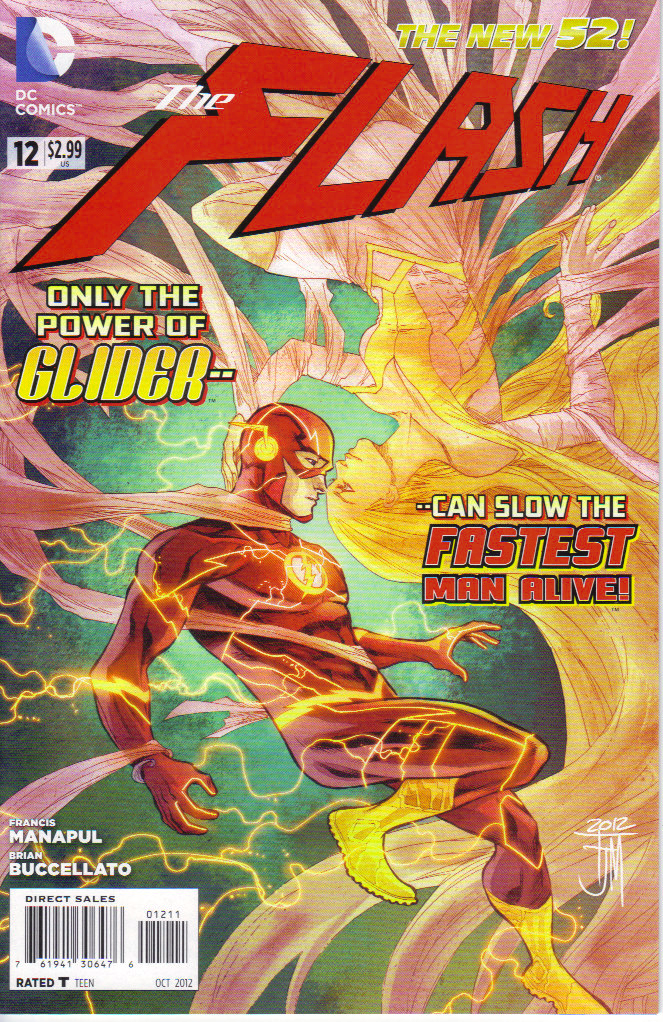
Similarly, there's little preparing for how incredible The Flash is, considering that most comics revitalized by the brilliant Geoff Johns end up shriveled on the vine (I'm looking at you, Hawkman and Justice Society). But this version of the fastest man alive, co-written by artist Francis Manapul and colorist Brian Buccellato, is an issue-for-issue masterpiece.

Manapul, once criticized publicly by writing partner Jim Shooter for weak cover art, now generates routine brilliance. Once establishing that the Flash should think as fast he moves, his writer/artists have sprinkled micro-panels throughout his world, illustrating our hero's quick moments of insight. Consistently iconic paneling also highlights the Flash's many Rogues, who frequently gang up against him (and each other). The cherry atop all of this is Buccellato's coloring, which is almost too beautiful for comics. Using subtle watercolor hues for the backgrounds, his boldly painted figures race through the Twin Cities of Keystone and Central.

This issue sees the Rogues Captain Cold and Heatwave under arrest and in armored transit. Cold's sister, the ethereal Glider, uses her phasing power to dump the police escorts and free Heatwave. Cold himself is rescued by the vigilante Pied Piper- in short, The Flash is never a dull read. Especially when Glider and Mirror Master steal a runaway monorail. I just have to wonder if Manapul would be so incredible if not made a fool of by an industry vet who should have had more class. Or maybe Shooter should run his mouth more often.


Saturday, August 18, 2012

Graphic Vibrance

"All of us so beautiful," says Reed Richards, leader of the Fantastic Four, "like a perfect emotional molecule turning in mathematical space." He speaks to his nemesis, Victor Von Doom, as they play a four-dimensional chess game that (naturally) threatens to destroy New York City. "I don't need my robot's eyes to crush you!" replies Doom, speaking indeed through the collapsed face of his gigantic mechanical doppelganger.

Now, if this had come from lesser imaginations than those of writer Grant Morrison and artist Jae Lee, the absurdity might validate comics' juvenile reputation. But Fantastic Four: 1234 is a series from 2001, published by Marvel under their Knights imprint, which specialized in mature, exotic takes on familiar characters. Morrison, with a fearlessly creative streak unrivaled in modern comic book writing, has built his career by successfully floating dense, bizarre concepts. Before going further, however, let me say that:

Reed is the brilliant Mr. Fantastic, who's also a human rubber band. His soulful wife, Susan, is the Invisible Woman. Johnny, her man-boy brother, is the Human Torch. Their best pal Ben Grimm is the rocky Thing (and my avatar). As Marvel's first family, they're the Fantastic Four. Writer Stan Lee and artist Jack Kirby launched their magazine in 1961 to answer DC's Justice League of America.

1234 explores the FF's essential cores, as they deal with friends (blind sculptress, Alicia Masters), foes (the egomaniacal Mole Man), and those who's loyalty comes and goes with the tides (Namor, the Sub-Mariner). That Doctor Doom will try to toy with their reality is a given; that Morrison will toy with his readers, and have Reed discover that Doom escaped into reality from his own dark psyche, is joyfully unexpected.

Settle down- that conceit only lasts a page. It's one of several crisp, poetic exchanges between the icons that give Lee room to not only strut, but cartwheel (and don't confuse him with famed X-Men artist Jim Lee, or he'll twist your pretty little head off). Most of his art from the early 2000s is texturally craggy, with statuesque figures seemingly adrift in melancholia. He's well matched by the always operatic Morrison.

Few writers, in fact, trust their creative partners to carry so many double-page spreads. Here, with one of the industry's finest pens at his command, Morrison's writing feels radically ethereal. When lesser scribes try to match the loftiness of Lee's art by doubling their word count, it gets ugly. Morrison never does. "Love is the name we use to pretty a savage genetic imperative," says Namor to Susan, with whom he's been obsessed for years. "Only you can calm the storm in my thoughts."

The speckled coloring of Jose Villarrubia is miraculous to behold. His hues run between rusty and aquatic, and bring warmth to Lee's stony surfaces, vast skies, and misty night encounters. My only minor quibble regards the printing of certain comic magazine pages, which appear blurry. This may not be the case in a 1234 trade collection, which is easily found in both hard and softcover editions.

Drawn with startling beauty, written with straightforward gusto by a man who sometimes stretches icons too far, Fantastic Four: 1234 has stuck to the wall, when so much from the House of Ideas doesn't. It's a reason I love comics.